

When I first wrote this guide, search engines were still the primary distribution channel for blog traffic.
Today the picture has changed: some users get the answer to their question directly from the AI summary on the results page, or from a chat assistant, without ever clicking through to a site.
This doesn’t fundamentally rewrite the blog-monetization equation, but it does redraw how risky each revenue model is.
I’ve updated this guide with that reality at its center.
1. How Can You Make Money From Your Blog?
There are many ways to make money by blogging. Here are the most popular and effective ones:
1.1. Affiliate Marketing

Affiliate marketing is the process of recommending products or services to your blog’s readers through special links.
When your readers use these links to purchase products, you earn a commission.
1.1.1. How Does It Work?
Special links are created by joining affiliate networks like ShareASale, ClickBank, or Amazon Associates, or by making direct arrangements with brands.
By promoting these products in your blog posts, you provide trustworthy, honest information that influences readers’ purchasing decisions.
Link clicks and sales can be tracked through dashboards.
If you’re writing from Turkey, put local programs on the table too. Global networks offer the advantage of dollar-based commissions, but if you’re producing Turkish content for a readership in Turkey, your conversion rate will likely be higher with local programs — because your readers are already customers of those platforms and are familiar with the payment and shipping process.
When choosing, look at three things: the commission rate, cookie duration (how many days after a user clicks a sale is still credited to you), and the minimum payout threshold. These three variables can multiply or divide the income you get from the same traffic.
1.1.2. Earning Potential
Affiliate marketing lets you earn income without having to create your own products.
Programs offering high-ticket products — electronics, jewelry, software — can generate substantial earnings.
How much you earn from affiliate marketing depends on your marketing strategy and creativity.
Even small blogs with niche audiences can earn high affiliate income, because what matters here is the number of qualified visitors.
So how much, exactly? Rather than answering this with ready-made figures floating around the internet, it’s more accurate to look at the calculation method itself — because earning ranges vary by niche, country, and the quality of your traffic.
The simple formula is this:
Monthly earnings = Monthly visitors × Link click-through rate × Purchase conversion rate × Average commission
Let’s build an example scenario (these aren’t real industry averages — they’re hypothetical numbers chosen purely to illustrate the calculation logic):
- 10,000 monthly visitors
- 5% of them click the affiliate link → 500 clicks
- 3% of those who click make a purchase → 15 sales
- Average commission per sale: 120 TL → 1,800 TL/month
Looking at this table, you’ll notice something: the cheapest way to double your income isn’t doubling your traffic — it’s improving your conversion rate. Raising the click-through rate from 5% to 8% with the same 10,000 visitors is far easier than finding 6,000 new visitors.
If you don’t know your own numbers, no estimate will be of any use to you. For the first three months, your goal shouldn’t be to make money — it should be to get to the point where you can measure these four variables.
1.1.3. Tips
Building a relationship of trust with your readers is essential; so you should only promote products you genuinely believe are good.
There’s also the legal side of things. Clearly disclosing the advertising relationship on affiliate links is required both ethically and from a search-engine standpoint.
Use a statement like “This post contains affiliate links” somewhere visible in the content, and add a rel="sponsored" tag to the links. Doing this won’t hurt your rankings; not doing it might.
1.2. Earning Income by Writing an E-book
Writing e-books is one of the most sustainable income sources you can build through your blog.
1.2.1. Why Is an E-book a Profitable Choice?
Since your blog readers already know your expertise and trust you, you’ll already have a ready-made customer base for any e-book you prepare for them.
1.2.2. What Topics Should You Write an E-book About?
You can base your e-book’s topic on your blog’s existing content.
Start by answering the following questions as you determine your topic:
- Do I have sufficient expertise on this topic?
- Do my readers want information on this topic?
- Are there similar e-books on the market, and how can I differentiate mine?
- Is this topic broad enough, or does it target too narrow a niche?
1.2.3. The E-book Writing Process
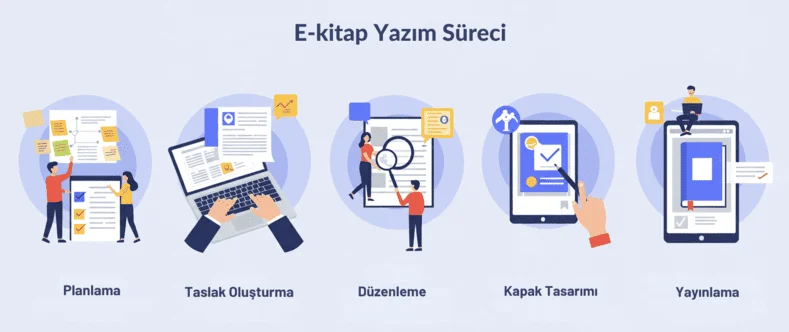
Before you start writing your e-book, make a detailed plan. Structure your content outline and decide which topics you’ll cover in which order.
Adjust your language and writing style based on your target reader’s level.
After writing your content, be sure to put it through an editing process.
1.2.4. Marketing and Promotion Strategies
Mention your e-book in your blog posts whenever the context is right, to catch your readers’ interest.
In these posts, you can share small excerpts from your e-book, and even offer some chapters for free.
Also reach your loyal followers by email to promote your e-book.
At the same time, quote excerpts from your e-book’s content on platforms like Instagram, LinkedIn, and X, and direct your followers to your blog.
Let me add a small but important note here. On social platforms, reach is no longer earned through hashtags — it’s earned through the content itself.
Adding a topic hashtag on X won’t bring you new readers; turning a single striking idea from your book into a thread will.
The same logic applies to LinkedIn.
1.2.5. Common Mistakes
1- The desire to make quick money shouldn’t push you into producing low-quality content. Products like this cause lasting damage to your brand in the long run.
Always focus on producing content that creates value and is genuinely useful to the reader.
2- The idea that “good content sells itself” is misleading. Even the highest-quality e-book won’t sell well without promotion.
3- Mass-producing content with AI and publishing it as is. As of 2026, this is the shortcut that ends up costing the most.
Google’s spam policies treat content that is produced at scale to manipulate search results as scaled content abuse, regardless of who or what produced it.
In other words, the issue isn’t whether you use AI or not — it’s whether you’re adding genuine value.
I cover this topic separately in section 1.9.4, because it’s no longer just a quality issue — it’s a direct revenue risk.
With patience, quality content, and the right marketing strategy, success will come in the long run.
1.3. Earning From Subscribers With an Email Newsletter

An email newsletter is one of the most effective ways to build an audience that regularly follows and engages with your blog.
By communicating directly with your readers, you can offer them exclusive content, deals, and recommendations.
This makes it possible to build a loyal subscriber base, which in turn increases your income potential.
Thanks to your email list, you can run campaigns targeted at your subscribers, offer personalized deals, and build a long-term revenue analysis.
To build a successful email newsletter, you need to send it regularly, respond quickly to subscriber requests, and continuously improve it.
Advantages of an email list:
- Independence from social media platforms
- Higher conversion rates
- The ability to offer personalized content
- The opportunity to build long-term customer relationships
At a time when AI search is suppressing blog traffic, the value of an email list has only grown. It’s the one channel no algorithm can stand between you and your audience.
1.3.1. How Does It Work?
An email newsletter strategy consists of three basic stages:
Subscriber Collection Stage: Collect your visitors’ email addresses using sign-up forms placed at the end, beginning, or middle of your blog posts. For this, you should offer valuable free content known as a “lead magnet”:
- Free e-books
- Checklists and templates
- Special guides and tips
- Downloadable resource packs
Value Delivery Stage: On a regular basis (weekly or biweekly), don’t just promote — send your subscribers content that delivers real value. This can be summaries of your blog posts, exclusive tips, industry news, or your personal experiences.
Monetization Stage: Once you’ve built trust, you can earn income by offering your subscribers exclusive deals. These offers should be exclusive to your email subscribers and should make them feel special.
1.3.2. Revenue Models
Direct Product Sales: Introduce your own products (e-book, online course, consulting service) to your email subscribers first. Subscribers show a higher tendency to buy than blog readers do.
Affiliate Marketing: Products you recommend in your email newsletter get much higher click and purchase rates than those in your blog posts, because your subscribers trust you more.
Sponsored Content: If you have a large email list (5,000+ subscribers), brands may pay you to feature their products in your newsletter.
Premium Subscription Model: Alongside your free newsletter, you can create a paid premium version that offers more detailed, exclusive content.
1.3.3. Turkey’s Legal Framework for Email Marketing: İYS and KVKK
Building an email list isn’t just a technical task — it’s also a matter with legal obligations attached.
What is İYS (the Message Management System)?
İYS is Turkey’s centralized system, overseen by the Ministry of Trade, where service providers sending commercial electronic messages are required to record and manage recipient consent. If you’re selling products, courses, or consulting through your blog, or running promotions in your newsletter, what you’re sending is very likely classed as a commercial electronic message.
What you need to do in practice:
- If you send commercial messages, register with İYS as a service provider and upload the consents you’ve collected into the system.
- When obtaining consent, follow the explicit consent principle: don’t use pre-checked consent boxes, and don’t hide the consent text.
- Offer an easy, free unsubscribe option in every message, and process opt-out requests without delay.
- Keep records of when, through which channel, and with what wording consent was obtained.
The KVKK (data-protection) side:
An email address is personal data. Therefore:
- Publish a privacy notice explaining what you collect and why.
- Use the data only for the purpose you’ve stated.
- If the email tool you use stores data abroad (most do), disclose this in your privacy policy.
- When a deletion request comes in, actually delete the record.
If you’re writing for a global audience, the same logic applies under the GDPR for the EU and CAN-SPAM for the US. The core principles — explicit consent, transparency, easy opt-out — overlap.
For up-to-date obligations, I recommend checking the primary sources directly: the Message Management System (İYS) and the Personal Data Protection Authority (KVKK). Regulations can change. Treat these as your reference, not this guide. If your volume grows, consulting a lawyer may be the right call.
1.3.4. Practical Tips for Success
Subject Line Optimization: Write attention-grabbing, curiosity-inducing subject lines to boost your open rates. Run A/B tests to learn which style performs better.
Segmentation: Group your subscribers by interest. Tech enthusiasts and people wanting to learn entrepreneurship may be interested in different content.
Personalization: Make your emails as personal as possible. Use names, share your own experiences, and write as if you were writing to a friend.
Consistency: Establish a regular sending schedule and stick to it. Your subscribers should know when to expect to hear from you.
1.4. Creating an Online Course

Creating an online course is one of the most profitable and sustainable ways to earn money from blogging.
You can prepare and sell video or written training in your area of expertise. This method offers both a way to share knowledge and an opportunity to earn income.
1.4.1. Why an Online Course?
Online courses are a natural extension of blogging. By going deeper into the knowledge you share on your blog, you can offer your followers a structured learning experience. This approach:
- Delivers a high profit margin: once you create a course, it can be sold an unlimited number of times
- Builds passive income: once the course is ready, automated sales systems can be set up
- Strengthens your authority: being a course instructor makes you perceived as an expert in your field
- Builds customer loyalty: students who take your course become potential customers for your future products
1.4.2. What Topics Should You Build a Course On?
Course topics you can develop from your blogging can include:
Courses Based on Blog Content:
- Go deeper on the posts on your blog that get the most engagement
- Create comprehensive training that answers your readers’ frequently asked questions
- Turn your “how-to” style posts into step-by-step video courses
Expertise-Based Courses:
- Pass on your professional experience (e.g., marketing, design, technology, etc.)
- Monetize your hobby (e.g., cooking, photography, music, etc.)
- Create courses on personal development topics
Skill-Building Courses:
Examples:
- Blog writing techniques
- SEO optimization
- Social media marketing
- Content creation strategies
1.4.3. Course Formats and Content Types
Video Courses:
- The most popular, effective format
- Practical demonstrations via screen recording
- On-camera presentations
- Animated explainer videos
- Recorded live webinars
Written Courses:
- Detailed PDF guides
- Interactive e-books
- Step-by-step worksheets
- Checklists and templates
Hybrid Formats:
- Video + written materials
- Audio recordings (podcast-style)
- Infographics and visuals
- Practical assignments and exercises
1.4.4. The Course-Building Process
1. Market Research and Target Audience Analysis: Clarify whose problem you’re solving, and which problem.
- Identify your most popular topics by examining your blog analytics
- Analyze the questions coming in from your readers
- Study competing courses to find where you can differentiate
- Survey your potential students
2. Building the Course Curriculum:
- Break the main topic into subtopics
- Set learning objectives for each section
- Arrange the content in a logical order
- Add practical exercises and assignments
3. Content Production:
- Prepare presentation slides and visual materials
- Keep each video short and focused (10-15 minutes is ideal)
4. Choosing a Course Platform:
Your platform choice directly determines how much of your revenue you actually keep. The main options:
- Marketplace model (Udemy, Skillshare, etc.): you get access to a ready-made audience, but your control over pricing and discount policy is limited, and revenue share favors the platform. The platform “owns” the student, not you.
- Your own platform (Teachable, Thinkific, Kajabi, Podia, etc.): you pay a fixed monthly fee, but the pricing, the brand, and the customer list are yours.
- Simple digital product sales (Gumroad, Lemon Squeezy, etc.): the lowest-friction route for one-off products and small bundles.
- Subscription/community-focused (Patreon, Substack’s paid newsletter and podcast features): a good option if you want to sell ongoing content rather than a course.
- Your own site (WordPress + plugins like MemberPress, LearnDash): the highest control, the highest technical responsibility.
Platform commission rates, payment terms, and whether they pay out to Turkey all change over time. That’s why I’m not giving figures here. Before deciding, always check the platform’s current pricing page and its ability to collect payment in TL/foreign currency yourself.
5. AI-assisted production: For tasks like drafting a curriculum outline, writing a video script, generating subtitles and transcripts, or preparing practice questions, AI tools visibly cut down preparation time.
But the same rule applies here too: AI builds the skeleton, you supply the experience.
What makes your course valuable is your subjective experience — something no one but you can tell.
6. Launch: A pre-registration list, early-bird pricing, limited-seats announcements, etc.
1.4.5. Pricing Strategies
Initial Pricing:
- Do market research for your first course.
- Examine the prices of competing courses.
- Evaluate your course’s value objectively.
Dynamic Pricing:
- Launch with an early-bird discount.
- Run seasonal campaigns.
- Sell bundles (3 courses together).
- Create loyalty programs.
1.4.6. Marketing and Sales Strategies
Marketing Through Your Blog:
- Share posts related to your course topic.
- Use course previews in your blog posts.
- Share success stories.
- Place call-to-action buttons in strategic spots.
Email Marketing:
- Build anticipation before the course launch.
- Offer exclusive discounts to your subscriber list.
- Share excerpts from the course content.
- Use student testimonials.
Social Media Strategy:
- Share your course-building process.
- Post short video clips.
- Answer questions during live streams.
- Collaborate with influencers.
Free Content Strategy:
- Offer the first module of the course for free.
- Create mini crash courses.
- Host webinars.
- Do podcast interviews.
1.4.7. Common Mistakes and How to Avoid Them
Content Mistakes:
- Don’t make videos that are too long (5-15 minutes is optimal).
- Failing to back theoretical knowledge with practical exercises.
- Neglecting audio and video quality.
- Sharing outdated information.
Marketing Mistakes:
- Announcing your course only once, without ongoing reminders.
- Pricing it too low or too high.
- Misdefining your target audience.
- Neglecting to use social proof (testimonials).
Technical Mistakes:
- Publishing the course without fully learning the platform’s features.
- Neglecting to test mobile compatibility.
- Neglecting to offer a course-completion certificate.
1.4.8. Tips for Long-Term Success
Quality-Focused Approach:
- Try to make each course better than the last.
- Take student feedback seriously and make improvements.
- Follow current developments in your field and update your courses.
Community Building:
- Create dedicated Facebook groups for your students.
- Highlight your successful students and share their stories.
Continuous Improvement:
- Study the work of other course instructors.
- Follow innovations in educational technology.
- Develop and personalize your own teaching style.
While creating an online course is a time-consuming process at the start, done right it can significantly increase the income you earn from blogging.
Be patient, focus on quality, and put your students’ success first. This approach will let you build a sustainable, growing online course business over the long run.
1.5. Building Paid Communities
- You can build membership-based communities around a specific topic.
- You can earn income by offering members exclusive content and support.
If you have a loyal readership, you can build a subscription-based revenue model by offering them exclusive content, perks, or experiences. This can provide a steady, predictable revenue stream.
1.5.1. Why a Community?
The community model generates recurring revenue instead of one-off sales. Members stay not only for your knowledge, but also for the connections they form with each other. This raises your retention rate.
Value you can offer:
- Q&A sessions
- Exclusive content and early access
- Networking among members
- Feedback and review sessions
1.5.2. Platforms
You can use community platforms like Discord, Slack, Circle, or Skool, or membership infrastructure on your own site (such as MemberPress).
Platforms like Substack and Patreon also let you manage a paid subscriber community.
When choosing a platform, go where your members already are. Convincing them to download a new app is harder than you’d think.
1.6. Sponsored Content and Brand Partnerships
Brands may want to publish content on your blog to reach your audience.
Done right, this model can be both high-income and reputation-building.
Five rules for sponsored content:
- Mark links correctly. Add
rel="sponsored"(andrel="nofollow"where appropriate) to any link that’s paid or part of a sponsorship relationship. This markup doesn’t stop the content from ranking — it just keeps the link from counting as a ranking signal. That should already be your intent anyway. - Write the content yourself. Publishing keyword-stuffed copy handed to you by the brand disrespects your readers and puts your quality signal at risk.
- Make the ad relationship visible. Include a line at the top of the post like “This content was created in partnership with Brand X.”
- Don’t stray outside your niche. Publishing gambling or credit content on a food blog is the textbook example of site-reputation abuse.
- Keep your distance from networks/marketplaces that sell placements. Setups that do bulk, automated placement with no editorial oversight are the ones that get caught fastest.
When setting your rate, don’t look only at your traffic — look at your audience quality, your standing in the industry, and how long the content will stay live.
1.6.1. How to Find Clients
A legitimate sponsored-content business is built through direct relationships, not through brokers who sell links:
- Reach out directly to the marketing teams of brands in your niche.
- Have your media kit ready (audience profile, average readership, sample work).
- Connect with marketing managers in your industry on LinkedIn; become visible by producing content.
- Contribute to discussions on X and in industry communities. Partnership offers mostly come from this kind of visibility.
Generate ideas instead of chasing hashtags. Brands pay the writer with an audience, not the hashtag.
1.7. Sponsored Posts and Paid Links
I recommended this type of income when I first wrote this guide. Since then, Google’s enforcement in this area has tightened significantly, so I no longer recommend it.
1.7.1. Why Can’t I Recommend the Same Thing Anymore?
Google’s spam policies target this model under two headings:
Link spam: Links given in exchange for money, products, or services in order to manipulate rankings are considered a policy violation. This applies to both the party selling the link and the party buying it.
Site reputation abuse: renting out a site’s existing authority to rank unrelated third-party content. Most of the practices carried out in Turkey under the name “sponsored post” fall exactly into this definition.
What’s the result? In the mildest scenario, the relevant pages drop in rankings. In the severe scenario, you get a manual action, and your domain loses most of its value in search results.
You end up putting a site you’ve spent years working on at risk for a few thousand lira in publishing income.
Note: In the first version of this guide, I said “use nofollow where appropriate.” That practice alone isn’t enough to avoid being classed as spam.
1.8. Direct Ad Sales
Companies may want to rent unused space on your blog to run ads. This model can become a highly profitable option, especially for high-traffic blogs.
1.8.1. Advantages of Direct Ad Sales
Unlike intermediary platforms like Google AdSense, making direct ad deals with companies offers a much higher income potential.
Blogs that specialize in a particular niche and have a targeted audience can gain a major advantage here.
- You don’t pay a commission to an intermediary — all the revenue stays with you.
- You set the price.
- You have full control over the ad’s appearance and placement.
- You can build predictable income through long-term deals.
1.8.2. Ad Types and Pricing Models
You generally sell ad space either for a fixed monthly fee or on an impression basis.
When setting your price, take into account your monthly pageviews, your audience quality, and the ad space’s position.
The underlying principle here is the same as described in “1.1.2. Earning Potential.”
You can’t set a price without knowing your own numbers.
Use your analytics data as the most concrete argument you have.
1.8.3. Protecting Reader Experience
While growing your ad revenue, protecting the reader experience is critically important.
Too many ads, or ads that are intrusive, can cause you to lose your loyal readers.
Take care to integrate ads in a way that’s consistent with your content and adds value.
1.9. Google (AdSense) Ad Revenue
Google AdSense is one of the most common and well-known ways to make money from your blog.
In this system, you place ads in specific areas of your website, and Google automatically displays ads relevant to your content and visitors.
1.9.1. How Does It Work?
For a long time, AdSense was explained using the phrase “pay per click.” This no longer accurately reflects the publisher experience.
Google has moved the payment model on the content-publisher side to a pay-per-impression structure and simplified the terminology.
This means your earnings are now calculated primarily based on how many times the ad is displayed.
Advertisers, on their end, can bid toward different goals such as clicks, impressions, or conversions. As a publisher, the metric you need to track is:
RPM (revenue per thousand impressions) = (Total earnings / Total pageviews) × 1000
Your RPM varies depending on your niche, the country your audience is in, device distribution, and your ad placements. In highly competitive verticals like finance, law, and software, RPM rises noticeably; in general-interest and entertainment verticals, it’s lower.
RPM for Turkish traffic is generally lower compared to traffic from Western Europe or North America.
I’m not giving exact figures, because these values change over time and planning around a single “average” would be misleading. For current conditions, follow resources directly from the Google AdSense Help Center.
1.9.2. Earning Potential
Don’t make AdSense the foundation of your revenue strategy. Do this simple math: if your RPM is low, the number of pageviews needed for meaningful monthly income is, for most blogs, a figure that takes years to reach.
With the same traffic, the income you’d earn from affiliate marketing or your own product is higher in almost every scenario. Position AdSense as “extra income from traffic you already have,” not as your main engine.
1.9.3. How Do AI Searches Affect Ad Revenue?
This is a topic I never touched on in the first version of this guide, but today it’s the most critical one.
AI overviews on search results pages, and chat assistants directly, can answer a user’s question without them ever visiting a site. On the publisher side, this translates to:
Impression-based revenue models are the most fragile ones. Because these models are directly tied to traffic volume, falling clicks pull revenue down one-to-one.
The degree of impact varies by content type:
- Most at risk: short, single-answer informational content (“what is X,” “how many calories does Y have,” “how do you calculate Z”). The answer to these questions is already given in the summary box.
- Better protected: content built on personal experience, comparative reviews, case studies, original data, and a strong point of view. Here, the user isn’t looking for “the answer” — they’re looking for “who’s saying it.”
What should you do about this?
- Decouple your income from traffic. Email list, your own product, community, consulting — none of these are tied one-to-one to pageviews.
- Optimize for conversion, not impressions. A small number of qualified visitors is worth more than a large number of shallow ones. Someone who reads the AI summary and still comes to your site has strong intent.
- Produce citable content. AI systems favor clear definitions, original data, and explicit structure when citing sources. This is the essence of what we call GEO (generative engine optimization). Being cited builds brand awareness even when it doesn’t bring a click.
- Grow your direct channels. Newsletter, podcast, YouTube, etc. Search is no longer the only door.
In short: AI search isn’t ending blogging — it’s making ad-focused blogging harder. Read the ordering of the models in this guide with that in mind (that’s why I put advertising last).
1.9.4. Content Quality Is Now a Direct Revenue Variable
Google’s quality and spam policies have recently become clearer on two points, and both directly affect your income:
Scaled content abuse: content produced at scale to manipulate search results — whether automated, AI-assisted, or made by hand, it makes no difference — is treated as a policy violation. The deciding question isn’t “how was it produced,” but “does it add genuine value for the reader.”
Experience-based authenticity (E-E-A-T): Experience, Expertise, Authoritativeness, and Trustworthiness. Of these, the one that’s hardest to fake and today the most distinguishing is experience. Actually having lived through a topic is the one input AI cannot produce.
What this means in practice:
- Write about the processes you’ve actually tried, the results you got, and the mistakes you made.
- Use your own screenshots, your own data, your own examples.
- Write about “the topic everyone covers” from “the angle only you know.”
- Use AI at the drafting, editing, and research stage — not at the stage of conveying experience.
This is no longer just SEO advice. It’s the prerequisite for every revenue line item that depends on traffic.
2. Strategy for Making Money by Blogging
2.1. Passive Income or Active Income?
It makes things easier to think of blog income in two categories:
Passive income items: e-books, online courses, affiliate, advertising. Set up once, they generate income repeatedly. But the word “passive” is misleading. The setup phase demands intensive effort, and if the system is left unmaintained, income drops.
Active income items: consulting, freelance writing, teaching classes, speaking. You sell your time — the ceiling is fixed, but cash flow starts quickly.
2.2. The Right Mix
For beginners, the healthy path is to start with active income and transition to passive income.
Consulting or freelance work both provides cash flow and teaches you the real customer problems that will define what your passive product should be about.
Don’t rely on a single income stream. Models dependent on advertising and search traffic in particular have grown more fragile. Setups that generate income from at least two channels — ideally three — are more resilient.
2.3. How Long Does It Take?
Honest answer: longer than you think.
For most blogs, the first meaningful income takes months to arrive. That’s because search visibility and trust are, by their nature, slow to build.
What’s more, this timeline can stretch even further as AI search becomes more widespread. In the past, “write good content, wait six months, let the traffic come” used to work. Today, part of that same content gets consumed in the summary box instead. So don’t bet solely on search traffic from day one — run email-list building and direct audience building in parallel. This is the most realistic way to shorten your payback period.
2.3.1. Consistency and Sustainability
Most people who fail to make money from blogging fail because of the quitting point. That quitting point is usually the exact month results would have started to show.
For sustainability:
- Set a publishing pace you can actually sustain (once a week, or even once every two weeks, is enough).
- Bet on quality over quantity — this is no longer a preference, it’s a policy requirement.
- Take updating old content as seriously as writing new content.
- Measure: which post brings traffic, and which brings revenue? These are usually not the same post.
2.4. Where Should You Start?

If you want to make money from your blog, the first step is to clarify your goals and your strengths.
Starting without a plan wastes time and can lower your motivation.
The steps below will help you make a deliberate, effective start.
2.4.1. Mapping Your Own Skills
- What are you good at? Writing, speaking, teaching, or analyzing?
- Which topics interest you? Choose areas you’re genuinely interested in, for the sake of long-term motivation.
- Where do your technical skills stand? Abilities like video editing, basic web design, and SEO knowledge affect your revenue model.
2.4.2. Starting a Small Blog or Content Channel
- Choose a topic and produce regular content on it.
- You don’t need to be professional at the start — what matters is consistency and a willingness to learn.
- Over time, your content quality will grow along with your audience.
2.4.3. Building Trust and a Loyal Community
- Create value, help people, be genuine and consistent.
- Try to build a loyal community through an email newsletter or social media.
- Trust is the foundation of earning income online: people don’t pay someone they don’t know.
2.5. How Do You Build a Revenue Funnel?

2.5.1. Funnel Logic
Blog income doesn’t happen in a single step. The reader goes through these stages:
- Awareness: they discover you through search, social media, or an AI assistant’s recommendation.
- Interest: they read your blog post and find it useful.
- Connection: they join your email list and start following you regularly.
- Trust: they receive value from you over several weeks.
- Purchase: they buy your paid product.
- Loyalty: they buy again and recommend you to others.
You lose people at every stage — that’s normal. The goal isn’t to eliminate the loss, but to improve the conversion rate a little at each stage.
2.5.2. The Critical Point in the Funnel: Step 3
Most blogs get stuck at step 2. The reader arrives, reads, and leaves — and never comes back.
The only mechanism that moves someone from awareness to connection is getting the reader’s permission to contact them.
That’s why the email list is the backbone of the funnel. (See 1.3.3 for the legal framework.)
2.5.3. Paid Products and Timing
When should you start selling a product? There’s no fixed timeline, but the following sequence works for most blogs:
- Months 1-3: produce content and clarify your positioning. Sell nothing. The only output of this period is making it clear what topic you’re credible on.
- Months 3-6: build your email list and prepare a lead magnet. Add your first affiliate links only for products you genuinely use.
- After month 6: release your first paid product. Start small. Instead of a comprehensive online course, prepare an e-book or template pack that solves a single problem.
- After month 9: design a more comprehensive product using the feedback from your first product.
- After month 12: diversify your revenue streams. Treat sponsored content and ad revenue at this stage as an extra layer on top of your main income, not the foundation.
Don’t read this timeline as gospel. If you already have an audience, the process can take weeks instead of months. If you’re starting from zero, it can take longer. What matters is the order: trust first, then the list, then the product.
***
Frequently Asked Questions
Can you really make money by blogging?
You can, but it’s not a fast or guaranteed path. A blog is less a revenue source and more a revenue infrastructure. The real money comes from the products and services you sell on the strength of the trust your blog earns you.
How much traffic do I need?
It depends on your revenue model, and the difference is bigger than you’d think. Ad revenue requires thousands of monthly pageviews. Selling your own product can work with just a few thousand qualified visitors. So instead of asking “is my traffic enough,” ask “is my audience the right one.” A well-targeted email list of 500 people will earn you more than 50,000 uninterested visitors.
Which revenue model should I start with?
If you’re starting from zero, order it this way: first active income (consulting, freelance writing, etc.), then affiliate, then your own digital product, and advertising last. The reason I leave advertising for last is its high traffic threshold and the fact that AI search has made this model the most fragile one.
Did AI end blogging?
No, but it shifted the center of gravity of the work. The value of purely informational content has fallen; the value of content built on experience, point of view, and original data has risen. The one thing AI cannot produce is what you’ve actually lived through.
Is producing content with AI risky?
The tool itself isn’t the risk — how you use it is. Using it to draft, edit, or speed up research is fine. Producing and publishing content in bulk, with no oversight and no original contribution, falls under scaled content abuse. The deciding question is: if I didn’t publish this content, would the reader lose anything?
 Share
Share X
X ChatGPT
 Perplexity
 Claude